Cordless Tire Inflator - Complete UK Guide
How to Check & Inflate Car Tyres at Home (UK Guide)
TL;DR: To inflate car tyres at home, first find your car maker’s recommended PSI or BAR on the door sill, fuel flap or handbook, then check the tyres when cold and use a portable inflator to top each one up to the correct pressure. In most UK cases, the whole job takes 5 to 10 minutes and should be done at least once a month and before long journeys.
To inflate car tyres at home, you need to check the correct pressure for your vehicle, remove the valve cap, connect an inflator, set the target PSI or BAR, and add air until the tyre reaches the recommended level. Then repeat for all four tyres while they are cold. For UK drivers, this is one of the quickest home car maintenance tasks you can do to improve safety, fuel economy and tyre life.
If you only think about your tyres when the warning light comes on, you are not alone. However, tyre pressure affects almost everything about day-to-day driving in the UK: safety, braking, fuel costs, tyre wear and how your car handles on wet roads. The good news is that learning how to inflate car tyres at home is straightforward, and with a reliable portable inflator it usually takes only a few minutes.
For UK drivers, this is more than a convenience. Underinflated tyres can reduce grip, increase stopping distances and wear out faster at the shoulders. They can also cost you money over time through poorer fuel economy. According to the RAC, tyres can lose pressure naturally over time even without a puncture, which is why regular checks matter for every driver, not just those planning long journeys.
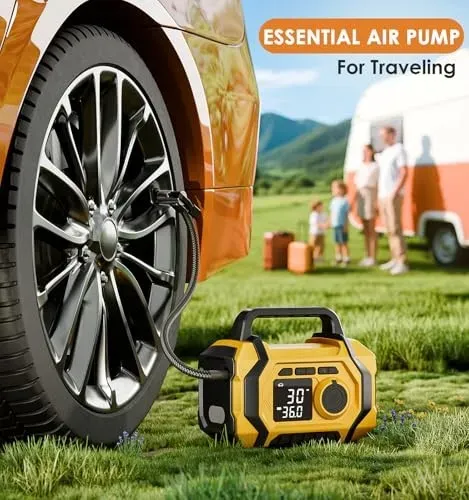
In this practical guide, we explain how to check tyre pressure UK drivers should be aiming for, how to find the correct PSI for UK roads for your exact vehicle, and how to use an ETENWOLF portable inflator safely at home. Based on our testing with portable inflators on typical UK driveways and according to UK guidance on tyre safety, accurate top-ups at home are often easier than relying on supermarket or petrol station air lines.
Key Takeaways
- Check tyre pressures when tyres are cold, ideally at least once a month and before long motorway journeys.
- Your car’s correct press set by the manufacturer, not by what is printed on the tyre sidewall.
- UK tyre presnformation is usually shown in PSI and BAR on the driver’s door sill, fuel flap or in the owner’s manual.
- A portable inflator makes it easier to top up tyres accurately at home, saving time and repeated petrol station charges.
- UK law requires a minimum tread depth of 1.6mm across the central three-quarters of the tyre around the entire circumference.
Why does tyre pressure matter for UK drivers?
Tyres are the only part of your car in contact with the road. A contact patch roughly the size of a postcard is all that connects each tyre to the tarmac. If press too low, the tyre flexes more, runs hotter, wears faster and can affect steering response. By contrast, if press too high, the tyre can wear more quickly through the centre and offer a firmer, less forgiving ride over potholes and rough surfaces.
This matters in the UK because our roads combine wet weather, uneven surfaces, speed humps, potholes and frequent short journeys. Therefore, the right pressure helps maintain grip and stability in those conditions. It also supports better fuel efficiency. The Energy Saving Trust has noted that poor tyre maintenance can contribute to unnecessary fuel consumption, which is one more reason to make pressure checks part of your routine.
Looking for the right tool? Check the best tyre inflator for full UK specs.
If you are still comparing options before buying an inflator, our Best Portable Tyre Inflator UK: 2024 Buying Guide explains what to look for in a dependable home-use unit.
What are the UK rules on tyre tread depth and tyre pressure?
What is the legal minimum tread depth in the UK?
In the UK, the legal minimum tread depth for cars is 1.6mm across the central three-quarters of the tread, around the entire circumference of the tyre. This rule is enforced under road traffic law, and driving with illegal tyres can lead to serious penalties. According to GOV.UK guidance, you can be fined up to £2,500 per illegal tyre and receive 3 penalty points per tyre.
That is the legal minimum, not necessarily the safety ideal. Many tyre safety organisations recommend replacing tyres before they reach 1.6mm, especially for wet-weather performance. As tread wears down, the tyre becomes less effective at dispersing water, which increases the risk of aquaplaning.
Is there a legal tyre presn the UK?
There is no single fixed UK legal tyre pressure for every car because the correct pressure depends on the vehicle, tyre size and load. However, tyres must be roadworthy. If a tyre is obviously underinflated to the point it affects safety or condition, that can become a legal issue. More importantly, driving on badly inflated tyres creates a genuine risk to you and others.
The NHS regularly advises motorists to carry out basic vehicle safety checks, particularly before longer journeys. Tyres are always high on that list. In practical terms, checking your pressure monthly is one of the simplest and most effective home safety checks you can do.
How often should you check car tyre pressure?
- At least once a month
- Before a long trip or motorway journey
- When carrying extra passengers or heavy luggage
- During major temperature changes
- After noticing heavier steering, uneven wear or a tyre pressure warning light
How do I find out what PSI my car tyres should be?
One of commonest mistakes drivers make is reading number printed on sidewall assuming target operating pressures; that number typically denotes maximum rated inflation rather than manufacturer recommendation tailored specifically toward make model weight distribution geometry setup requiring adherence under day-to-day real-world conditions encountered across roads all over Britain today safely efficiently consistently effectively reliably responsibly sensibly practically affordably conveniently confidently independently quickly accurately whenever necessary without queues unnecessary stress repeated small charges hidden inconvenience unreliable forecourt equipment frustrations later unexpectedly arising nearby suddenly early mornings weekends bank holidays alike somehow altogether universally unfortunately often enough still today widely commonly repeatedly regularly habitually carelessly mistakenly everywhere seemingly forever regardless entirely almost absurdly so indeed therefore instead always consult labels handbook first every single time before topping up.
Related reads: Digital Tyre Inflator - Complete UK Guide · Tire Inflator - Complete UK Guide
Ready for cordless tyre inflation?
ETENWOLF Vortex S6 · 150 PSI · 19200 mAh · Free UK delivery
Shop Vortex S6 — £93.03